
In the West Philippine Sea, the stakes are high, and the waters are contested. Here, survival belongs to the one who sees first. But when the eyes watching these waters aren’t yours, how long before you start asking why?
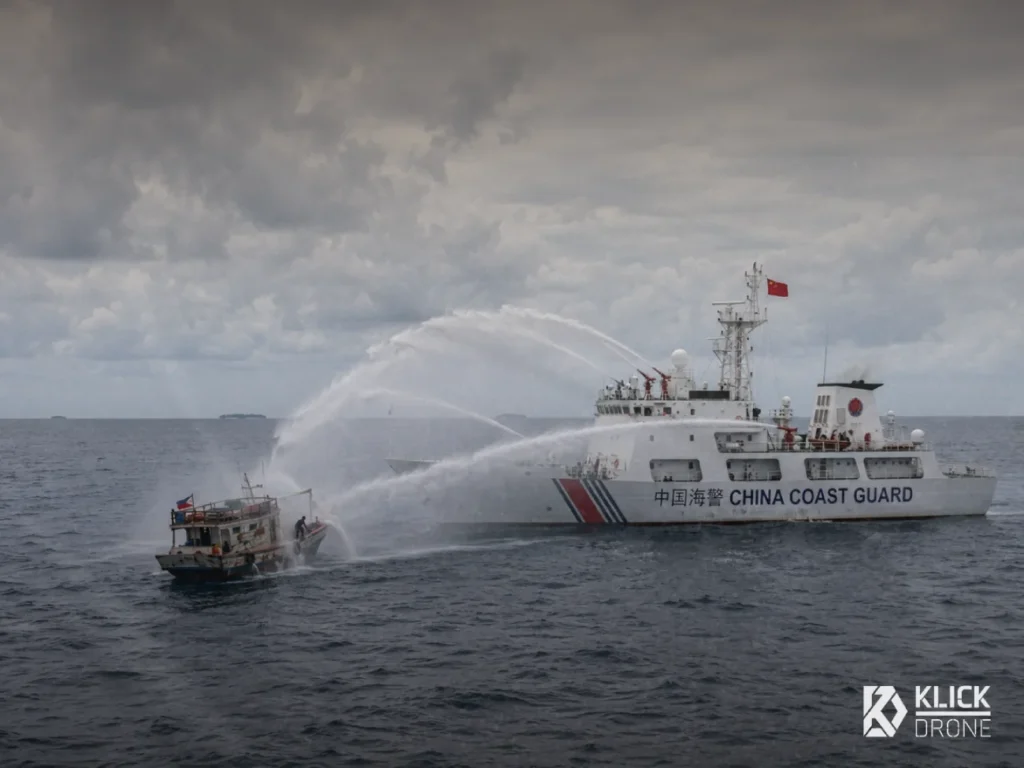
As daylight slowly lightens the deep indigo of the ocean, two vessels come into contact at a disputed shoal. It’s a scene all too familiar around the Scarborough and Sabina Shoals, where ships from the Philippines and China meet, often in heated confrontation.
There are plenty of fish in the sea, they say. Yet few carry the richness of the West Philippine Sea, with fishing grounds that support millions, untapped energy reserves beneath its seabed, and control over trade routes and military reach, making it one of the most contested maritime arenas in the Indo-Pacific.
THE INDO-PACIFIC CONTENDERS
For years, the main players in this arena have been the Philippines and China, making headlines from collisions and water cannon incidents to mutual accusations of provocation.
But there’s another player: the United States.
The U.S. supports the Philippines as an advocate for freedom of navigation and as a counterbalance to China’s growing operations in the South China Sea. Joint military cooperation has been strengthened, with over 500 bilateral exercises scheduled for 2024–2026, including Balikatan. This annual military exercise brings together the Armed Forces of the Philippines (AFP) and U.S. forces to train “shoulder-to-shoulder”, further strengthening their relationship as they develop through physical and intellectual training.
Although the 12th US-Philippines Bilateral Strategic Dialogue committed to increasing deployments of U.S. missile and unmanned systems to Philippine territory, these plans address only part of the challenge.
In contested waters, what we often see may not be as it seems. A fishing boat could carry an honest fisherman or a paramilitary force from the Chinese Maritime Militia.
In such uncertainties, decisions really have to go beyond initial observations. Waters with challenging terrain, such as the Indo-Pacific, test the crew’s nerve, leaving them unsure when an adversary is moving.
Some dangers even lurk beyond view; communications falter, and storms blind sensors. So when interference strips away the last layer of visibility, what remains is a human problem, and that’s the creeping uncertainty of not knowing what’s out there.
That uncertainty has only ever had one answer: the force that sees first.
SEEING IS SURVIVING
The force has “eyes” for its military operation. But we’re putting weight on more than just being able to see; it’s about seeing at the right place, at the right time.
Unmanned Aerial Systems (UAS) have long been primary tools for Intelligence, Surveillance, and Reconnaissance (ISR). But most are built for permissive environments where it’s calm, predictable, and with little interference.
The Indo-Pacific is anything but that. Its vastness stretches coverage thin, and its contested nature makes stealth difficult and communication unreliable.
What the force needs isn’t just another system. It needs an extended gaze, one that’s built for these specific conditions, operated on its own terms, available when its own decisions need to be made. A surveillance capability that does not depend on someone else’s schedule or priorities.
Because you know what’s worse than not having an eye?
It’s having an eye that’s not yours.
In this environment, surveillance is no longer a support function—it is survival.
THE EYE THAT ISN’T OURS
The Philippines does not watch its waters alone.
Radar systems line its coasts. Intelligence flows through bilateral agreements. Allied vessels patrol nearby, and surveillance feeds arrive from partners who have invested heavily in keeping our region covered.
On paper, the picture looks complete; we have a web of eyes watching over us.
But you see, looking through someone else’s eye means the view is shaped by the priorities of whoever built it.
The systems watching the West Philippine Sea were not all built for the Philippines. Some were designed with a partner’s strategic priorities in mind. A coverage that happens to include Philippine waters because it serves a broader regional purpose. The intelligence that arrives through shared agreements passes through filters, priorities, and processes that the country did not set and cannot fully control. The equipment donated or transferred comes with technical dependencies of maintenance contracts, data architectures, and interoperability requirements that quietly tether Philippine operations to decisions made elsewhere.
But to be clear, none of this makes the partnerships less valuable. It’s just that there is a difference between being watched over and being able to watch for yourself.
And for most of our modern history, the Philippines has lived on the first side of that line.
Its maritime awareness has been assembled from pieces that were borrowed here, donated there, jointly operated somewhere else, all held together by goodwill and alliance architecture that, however strong, was never entirely our own.
Consider this: it took until 2025 for the Philippines to receive a modern, purpose-built long-range maritime patrol aircraft designed for persistent ISR operations. For decades before that, one of the world’s most contested bodies of water relied heavily on aging aircraft, limited domestic surveillance capability, and intelligence support that the Philippines did not fully control.
That is not an indictment of any partner. It is simply what the picture looks like when you step back far enough to see it whole.
And when you see it whole, a quieter question emerges, not about who is watching, but about what happens when the eye that watches isn’t yours? When the coverage shifts. When the priorities change. When the alliance, however strong, is pulled in another direction.
What does the Philippines see then?
That condition has a name. It just hasn’t been spoken aloud.
WHEN SURVEILLANCE BECOMES SOVEREIGN
Daylight shines again over the same waters, the same shoal. And the same vessels meet at the edge of what is known and what isn’t.
But something is different now.
Not in the waters, which remain as contested, as uncertain, and as unforgiving as they have always been. The difference is quieter than that. It is in who is watching.
For a long time, the eye over these waters belonged to many; our partners, allies, and systems built elsewhere and pointed here out of shared interest.
Now, in the same region where that dependency took root, something is being built that answers to a different set of priorities. Not imported. Not donated. Not maintained under someone else’s technical framework. Designed around these specific waters, these specific conditions, by people who don’t have the luxury of watching from a distance but from up close, because this is their sea.
It is in its early stages. After all, no single development resolves what took decades to build. But it changes the direction, the path that the country can take.
And in waters where everything is decided by who sees first, direction is everything.
A Filipino-founded defense manufacturer has already made that decision. Quietly, without announcement, building UAS designed not for someone else’s theater of operations, but for these waters and for the people who have to live with what the eye sees.
And the unnamed condition? It’s surveillance without sovereignty. Now, it may finally have its answer.
Not a borrowed one.
One that, for the first time, is entirely our own.
Sources
- Council on Foreign Relations — Territorial Disputes in the South China Sea
- Naval News — Philippines Challenges Chinese Forces at Scarborough Shoal
- Interaksyon / Philstar — U.S. Stands with the Philippines on South China Sea Issue
- The Guardian — China’s Maritime Militia in the South China Sea
- U.S. Embassy in the Philippines — Philippines-U.S. Bilateral Strategic Dialogue
- U.S. Marine Corps Forces Pacific — Philippines and U.S. Conclude Balikatan Exercises
- Indo-Pacific Defense Forum — Enhanced Missile Defense and Philippines-U.S. Engagements
- International Crisis Group — The Philippines’ Military Modernisation Effort
- USNI News — Philippines to Receive Surveillance Aircraft
- Army Recognition — Philippines Receives ATR 72-600MPA Maritime Patrol Aircraft
- War Power Philippines — Drone Force
- Asia Maritime Transparency Initiative — Assessing the Philippines’ Maritime Governance Capacity
- Army Recognition — U.S. Marine Corps MQ-9A Reaper Drones Reinforce Philippine Surveillance
- South China Morning Post — Philippines and U.S. Sign Pact to Address Maritime Intelligence Gaps
- Second Line of Defense — U.S.-Philippines Military Cooperation and Unmanned Systems
- World Socialist Web Site — Philippines, U.S. and South China Sea Developments